
The United Negro College Fund (UNCF) was founded on April 25, 1944, by Tuskegee Institute president Frederick D. Patterson, educator Mary McLeod Bethune, and other Black educational leaders.
The goal was to coordinate and increase funding for America’s historically Black colleges and universities and provide scholarships for Black students. It has had amazing success in achieving those goals, raising billions of dollars that have helped hundreds of thousands of students.
But the visibility of UNCF was not especially high until 1972.
That’s when it launched a new nationwide fundraising ad campaign that featured the memorable slogan “A Mind Is a Terrible Thing to Waste.”
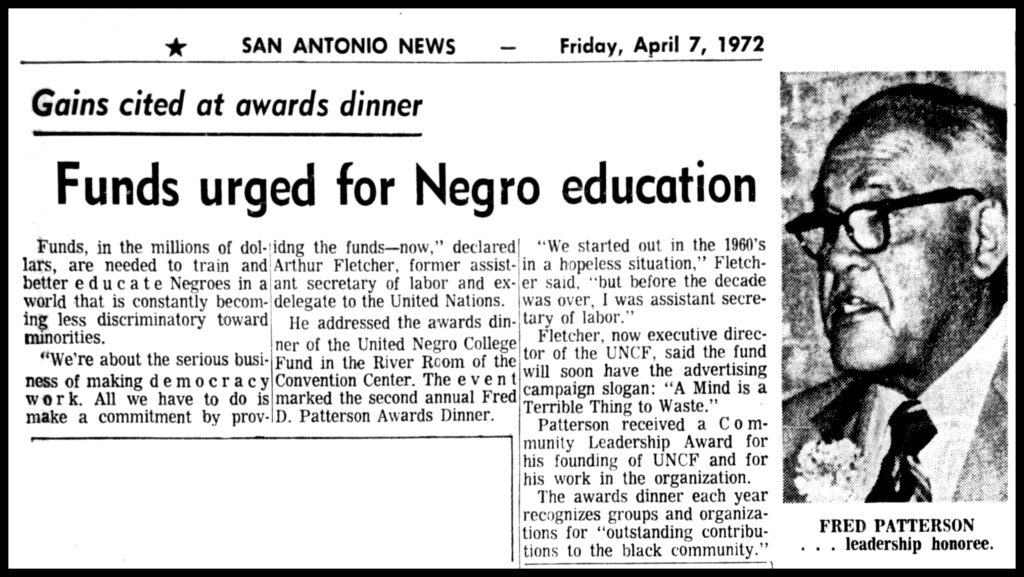
Newspaper clips indicate that Arthur Fletcher, Executive Director of the UNCF, publicly announced the campaign at a UNCF awards dinner on April 7, 1972.
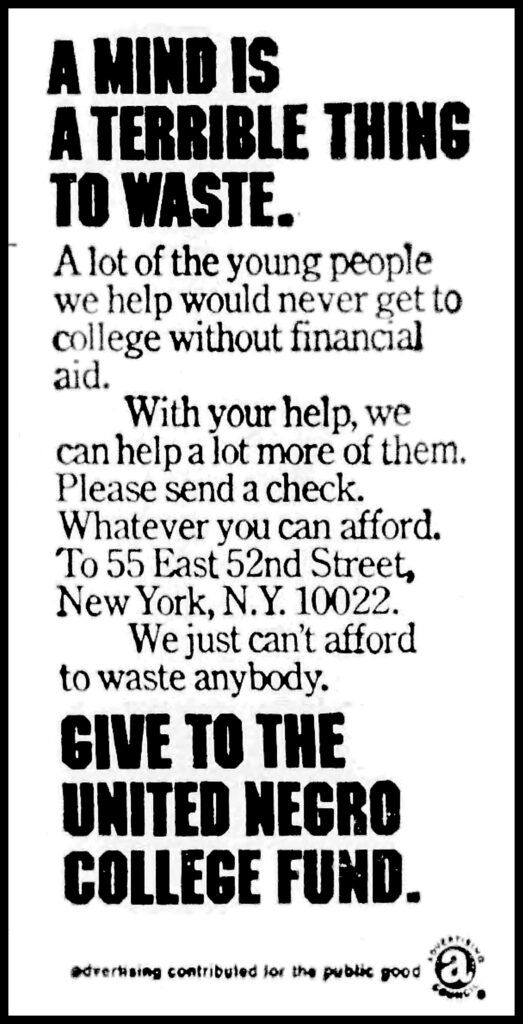
That line was coined by Forest Long, a copywriter and executive at the Young & Rubicam agency. Long said he viewed the slogan as “a plea to everybody to reject the prejudices of the past and consider the inner person.”
The ad campaign using Long’s slogan was coordinated by the Ad Council, a nonprofit organization whose original mission was to help mobilize public support for war-related efforts during World War II.
After the war, at President Harry Truman’s urging, it continued as a peacetime organization devoted to public-service campaigns.
In the wake of the Civil Rights Movement and riots of the 1960s, there was an underlying concept in the slogan that resonated. It invited everyone to do something positive for race relations and America by helping young African Americans achieve their potential and become productive members of society.
Working with advertising agencies who donated their time and talent and media companies that donated advertising space and airtime, the Ad Council has since supported many different public service advertising programs.
Among its best-known campaigns and slogans are Smokey Bear’s “Only You Can Prevent Forest Fires,” the National Highway Traffic Safety Administration’s “Friends Don’t Let Friends Drive Drunk,” and the UNCF’s “A Mind Is a Terrible Thing to Waste.”
The campaign featuring Long’s slogan helped make the UNCF’s fundraising efforts extraordinarily successful. It was also trademarked by the organization and incorporated into its official logo.
Since 1972, the UNCF has raised more than $6 billion in donations, awarded tens of thousands of scholarships annually, and helped more than 500,000 students earn college degrees.
As often happens with memorable ad slogans, “A Mind Is a Terrible Thing to Waste” has become a saying used far beyond its original purpose.
Over the decades, it has been quoted, repurposed, parodied, and adapted in countless ways.
My favorite use is in Mel Brooks’ 1993 comedy Robin Hood: Men in Tights. In one scene, a mime tries to entertain the Sheriff of Rottingham (actor Roger Rees) and Prince John (Richard Lewis) at a banquet. The Sheriff is not impressed. “Kill him!” he says to his guards. Prince John comments: “Wait! You know, a mime is a terrible thing to waste.” The Sheriff decides to let the mime go.
Another funny film takeoff is in Steel Magnolias (1989). In that, Shirley MacLaine’s character, Ouiser Boudreaux, responds to a friend’s nosy question about her love life by saying: “A dirty mind is a terrible thing to waste.”
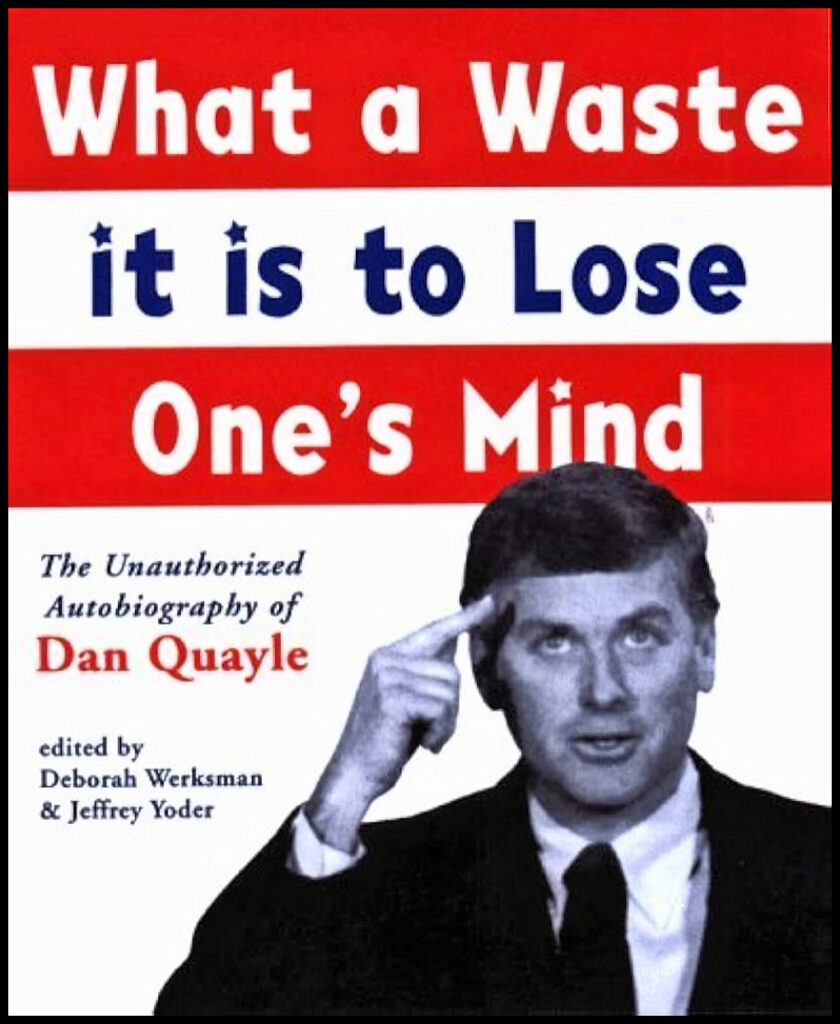
The most infamous variation of the slogan was unintentional. On May 9, 1989, Vice President Dan Quayle was speaking at a United Negro College Fund event. At one point, he attempted to quote the slogan but instead uttered one of his best-known verbal blunders.
Quayle said: “When you take the UNCF model that, what a waste it is to lose one’s mind, or not to have a mind is being very wasteful, how true that is.”
That quickly became one of the most-cited “Quaylisms” and, among other things, inspired the title of the 1992 book What a Waste It Is to Lose One’s Mind: The Unauthorized Autobiography of Dan Quayle.
In 2013, the UNCF added to the famous slogan in a new series of advertisements that said: “A mind is a terrible thing to waste but a wonderful thing to invest in.”
However, it’s the original version that most people know. More than fifty years after Forest Long coined it, his eight simple words are still among the most memorable ever written for a public-service campaign.
Comments? Corrections? Questions? Post them on the Famous Quotations Facebook page
or email me at the address shown on the “About” page for this blog. © Subtropic Productions 2026
* * * * * * * * * *

RELATED READING, VIEWING & OTHER STUFF…





![The Mind Is a Terrible Thing to Taste [Explicit]](https://m.media-amazon.com/images/I/41BwvA0hLtL._SL500_.jpg)