

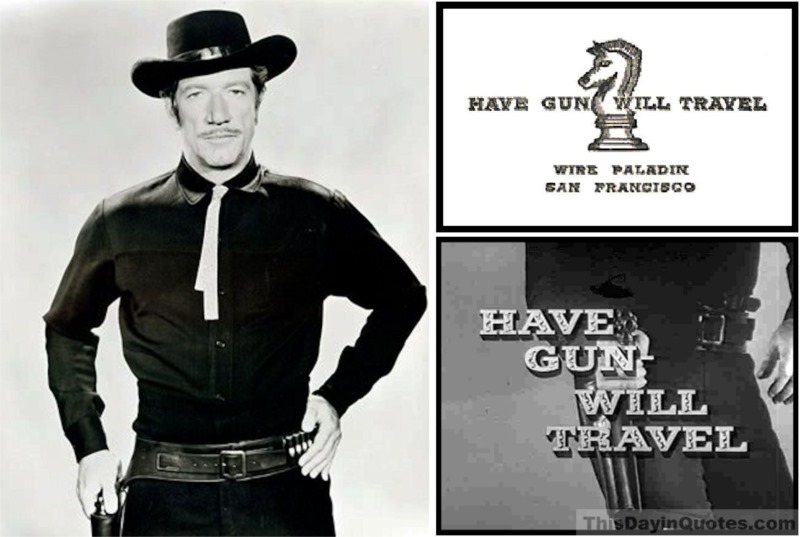
Today, the linguistic formula “Have X [some work tool] – Will Y [do something]” is firmly cemented into our language.
Prior to the 1950s, it wasn’t.
On September 14, 1957, the great Western television series Have Gun – Will Travel premiered on the CBS network. (The first episode was titled “Three Bells to Perdido.”)
The show’s title helped turn the word formula “Have X – Will Travel” into what linguists call a “snowclone.”
The term snowclone was coined by economist Glen Whitman in 2004 in an exchange with linguist Geoffrey Pullum on the Language Log weblog. It is applied to well-known clichés or “phrasal templates” that are recycled in multiple ways with varying words. Examples are catchphrases like “We don’t need no stinking X,” or “I’m not an X, but I play one on TV” or advertising slogans like “Got X?”
I once assumed the TV show Have Gun – Will Travel was the origin of the Have X – Will Y snowclone. But when I researched it for this post, I found out that the formula predates TV show. As noted in this Wikipedia post, the earliest known literary mention of the template “Have X, will travel” is the title of the book Have Tux, Will Travel, a 1954 memoir by comedian Bob Hope. Hope said “Have tuxedo, will travel” was a stock phrase used in short advertisements placed by actors in Variety, indicating that the actor was “ready to go any place any time” and to be “dressed classy” upon arrival. Variations of this template by job seekers is said to go back even earlier, to at least the 1920s.
Over the decades, there have been countless variants. In addition the the title of the Western TV series, some of the best-known examples are Robert A. Heinlein’s 1958 novel Have Space Suit—Will Travel, Richard Berry‘s 1959 song “Have Love, Will Travel,” Bo Diddley‘s 1960 album Have Guitar Will Travel, The Three Stooges 1959 film Have Rocket, Will Travel and Joe Perry’s 2009 album Have Guitar, Will Travel.
I would note that those best-known examples came after the TV show Have Gun – Will Travel became a huge hit. So, my guess is that it played a major role in making “Have X, will travel” a famous snowclone.
Have Gun – Will Travel starred Richard Boone as the main character, Paladin. Yep, just Paladin. A famous mononym. His first name was never revealed during the course of the series.

Paladin was what could be called a problem solving consultant, though most people thought of him as a professional gunfighter for hire.
He tried to make sure he only worked for people who were on the right side of some issue or problem. And, he tried to settle things without violence if he could. But he could draw and fire a gun faster than, well, anyone he had to deal with in the show.
So, if you drew against Paladin, you were probably a bad guy or stupid. And, if you drew against Paladin, you’d probably end up dead.
In work mode, Paladin dressed in black and carried a Colt .45 six-shooter in a distinctive holster embossed with a metal image of a chess knight, a piece associated with medieval knights in armor, once referred to as “paladins.”
When he wasn’t working, Paladin lived the life of a fancily-dressed dude who lived in San Francisco. That’s where people could contact him, as noted in his enigmatic business card, which also had the image of a chess knight, along with the memorable words: “Have Gun Will Travel. Wire Paladin. San Francisco.”
The card didn’t mention that Paladin lived at The Carlton Hotel, but somehow they got to him there. Messages for Paladin would usually be delivered by the hotel’s Chinese bellhop Hey Boy (played by actor Kam Tong) or by his replacement in the last two seasons, Hey Girl (Lisa Lu).
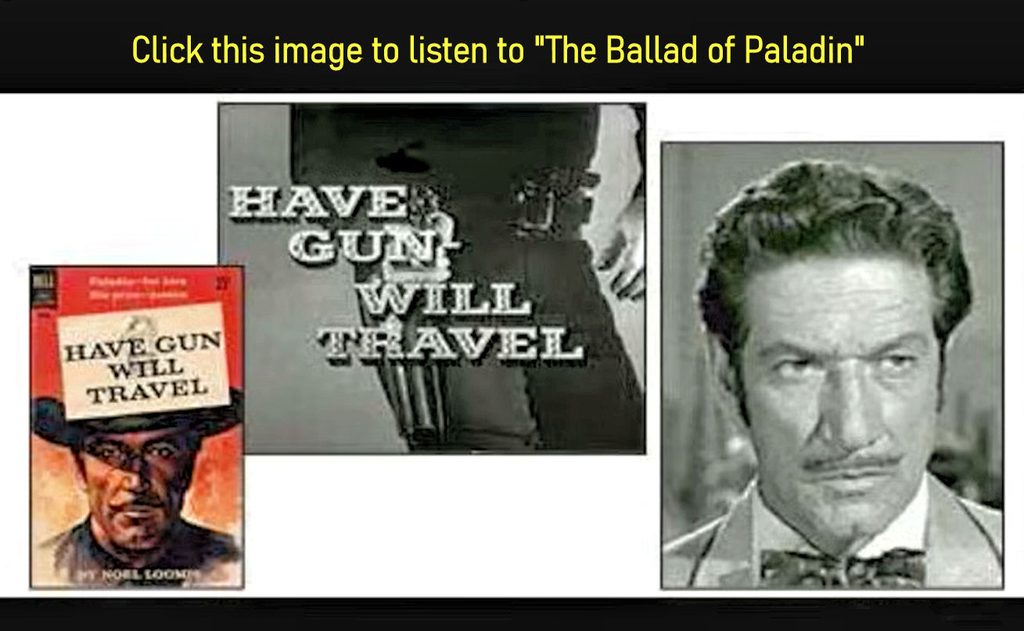
Have Gun – Will Travel ran for 225 episodes, originally aired for six seasons, from 1957 to 1963. The show was so popular that it became one of the few TV shows that spawned a radio version. The radio series starred popular character actor John Dehner as Paladin and ran on the CBS Radio Network for two years, from 1958 to 1960.
When the TV series first aired, I watched it every week as a kid, on my family’s grainy black-and-white TV.
Nowadays, I still watch episodes now and then. They can be viewed streaming on YouTube and on cable TV channels that feature “classic television” shows.
Sometimes, I still sing along when the show’s theme song, “The Ballad of Paladin,” plays at the end of an episode. That memorable song was written by Johnny Western, Richard Boone, and Sam Rolfe and performed by Johnny Western. Click this link or the image above and sing along with me:
“Have gun will travel reads the card of a man
A knight without armor in a savage land
His fast gun for hire, heeds the calling wind
A soldier of fortune, is a man called — Paladin
Paladin, Paladin, where do you roam
Paladin, Paladin, far, far from home”
* * * * *
Comments? Corrections? Questions? Post them on the Famous Quotations Facebook page
or email me at the address shown on the “About” page for this blog. © Subtropic Productions 2026

RELATED READING, VIEWING & OTHER STUFF…


