
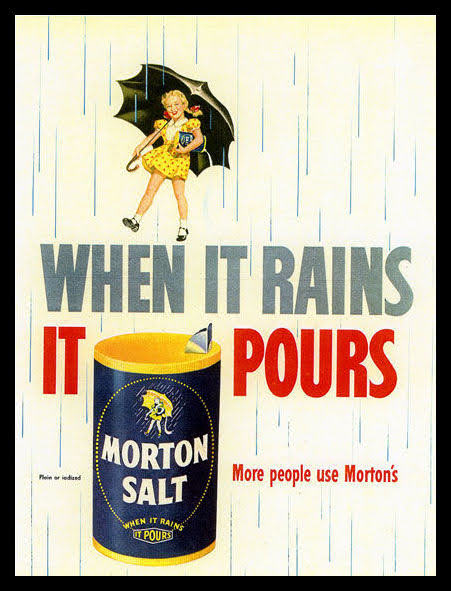
Back in November 2009, not long after I first started writing this blog, I happened to see two news stories in a row that had quotes using the saying “When it rains it pours.”
One was a story about the Boston Bruins hockey team, which had just lost another in a series of losing games. Player Blake Wheeler told a reporter the team’s losing streak was “a when it rains, it pours type of thing.”
That same day, I saw an article about the controversy over a health care amendment leading Democrats had floated in Congress.
In the story, Republican Congressman Dave Camp from Michigan was quoted as saying: “When it rains it pours. This amendment only increases the government involvement in health care, raises more taxes and opens more taxpayer subsidies to illegal immigrants.”
After seeing the two back-to-back uses, I decided to look up the origin of this idiomatic expression.
One of the interesting things I found was that, while “when it rains, it pours” commonly has a negative connotation, the original, high-profile use that popularized the saying was designed to be positive.
It dates back to 1911, when the Morton Salt Company developed a new breakthrough in table salt technology.
Until then, most table salt was sold in a raw, coarse-grained form that clumped and caked when rainy weather made the air in a house even slightly humid.

The Morton food scientists solved this problem by reducing the grain size and adding a small amount of magnesium carbonate, an anti-caking agent.
As a result, the salt didn’t cake and clump. It could be poured or shaken out as nicely as dry sand, even when it was humid indoors due to the weather.
The Morton execs asked their ad agency – the renowned N.W. Ayer & Son firm – to create a catchy ad slogan for this new and improved salt.
Morton rejected a couple of initial slogan ideas, but the Ayer admen eventually came up with a winner: “When it rains, it pours.”
It was an updated, positive twist on the old English proverb “It never rains but it pours,” which had a negative connotation, suggesting that when troubles come, they come one after the other.
As expected, American consumers, who previously had to put up with inconveniently clumpy salt when the humidity was high, understood exactly what the Morton slogan meant.
It meant that Morton Salt would stay dry and come out of the box or shaker perfectly, even when it was raining outside and humid inside.
That was indeed a very good thing. Nonetheless, over time, the Americanized version of the old English proverb typically came to be used in a negative way, like its forbear.
The Ayer firm also created an image of a little girl with an umbrella to go with the slogan. This famous combination was trademarked by Morton and, according to US Trademark registration information, first used in commerce on November 6, 1914.
Over the decades, the image of the “Umbrella Girl” on boxes of Morton salt has evolved.
The company has adopted other marketing slogans. And, few people today ever think about the “problem” of clumping salt.
* * * * * * * * * *
Comments? Corrections? Questions? Email me or post them on my Famous Quotations Facebook page.
Related reading…