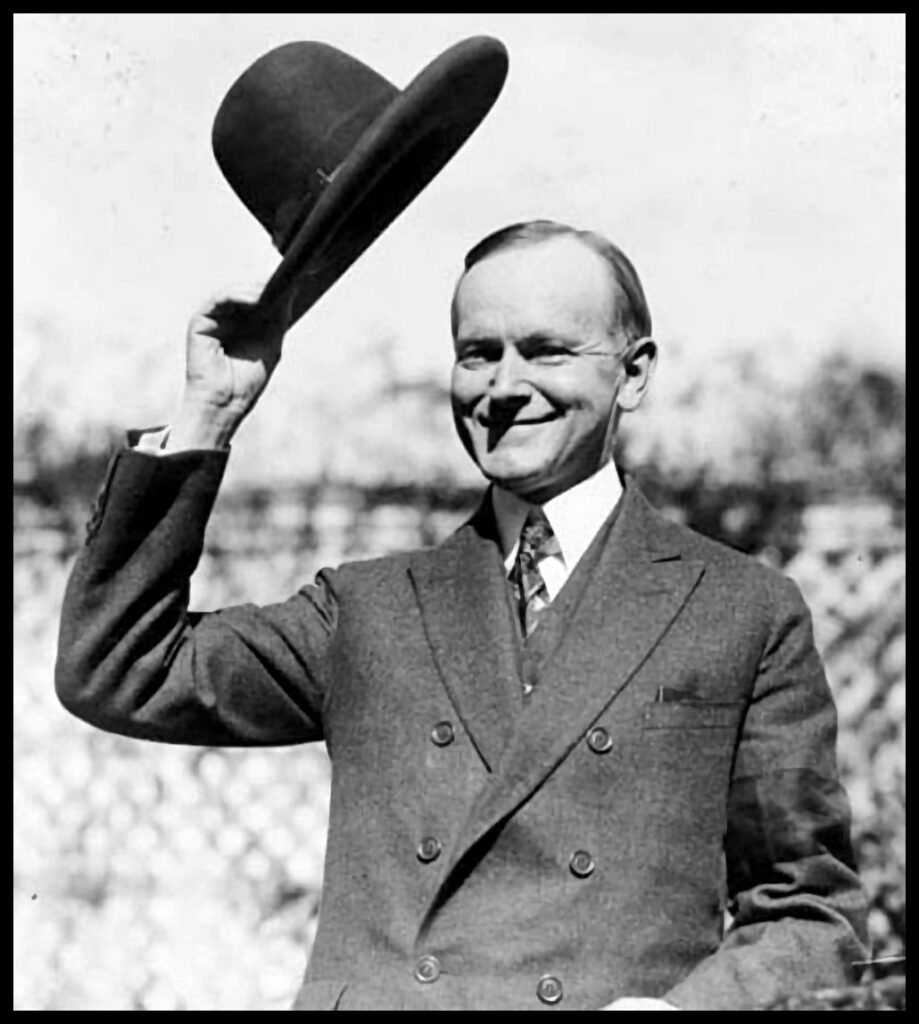
When President Warren G. Harding died from a heart-related problem in 1923, Vice President Calvin Coolidge became the 30th President of the United States.
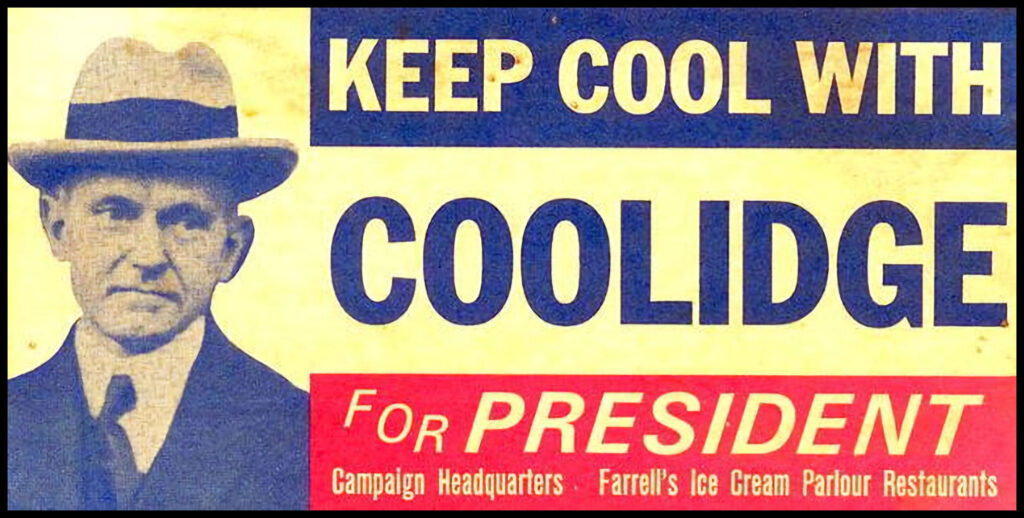
The following year, with his popularity buoyed by a strong economy of the “Roaring Twenties”, Coolidge handily won the 1924 presidential election, using the campaign slogan “Keep Cool With Coolidge.”
Unlike some presidents, “Silent Cal” Coolidge wasn’t known for making memorable statements.
The most famous quote associated with him is a line about business being the business of America.
That line is often given as “The business of America is business” or “The business of the American people is business.”
In fact, both of those versions are misquotes.
They aren’t radically different from what he actually said, which was “the chief business of the American people is business.”
However, when this short quote or the misquote versions are cited alone, out of context, they tend to give the inaccurate impression that Coolidge was a totally one-dimensional, pro-business cheerleader.
President Coolidge made his famous remark in an address to the Society of American Newspaper Editors on January 17, 1925 in Washington, D.C.
The speech he gave that day was titled “The Press Under a Free Government.” It focused on the role of the press in free market democracies, like America.
Coolidge noted that the press was far more likely to publish propaganda in autocratic or Socialist countries.
He acknowledged concerns about whether business considerations could affect editorial positions and news reporting in a society like the US. But he pointed out the flip side, saying:
“There does not seem to be cause for alarm in the dual relationship of the press to the public, whereby it is on one side a purveyor of information and opinion and on the other side a purely business enterprise. Rather, it is probable that a press which maintains an intimate touch with the business currents of the nation, is likely to be more reliable than it would be if it were a stranger to these influences.”
Then Coolidge added his famous quote:
“After all, the chief business of the American people is business. They are profoundly concerned with producing, buying, selling, investing and prospering in the world. I am strongly of the opinion that the great majority of people will always find these the moving impulses of our life.”
It’s hard to dispute the notion that most Americans are concerned about the economy and personal prosperity. And, Coolidge made it clear that he didn’t simply mean “greed is good.”
“Of course, the accumulation of wealth cannot be justified as the chief end of existence,” he said. “But we are compelled to recognize it as a means to well-nigh every desirable achievement. So long as wealth is made the means and not the end, we need not greatly fear it…But it calls for additional effort to avoid even the appearance of the evil of selfishness. In every worthy profession, of course, there will always be a minority who will appeal to the baser instinct. There always have been, probably always will be, some who will feel that their own temporary interest may be furthered by betraying the interest of others.”
Coolidge said the accumulation of wealth should be a means to the “multiplication of schools, the increase of knowledge, the dissemination of intelligence, the encouragement of science, the broadening of outlook, the expansion of liberties, and the widening of culture.” He also said something that would be a much more inspiring quote for him to be remembered by:
“The chief ideal of the American people is idealism. I cannot repeat too often that America is a nation of idealists.”
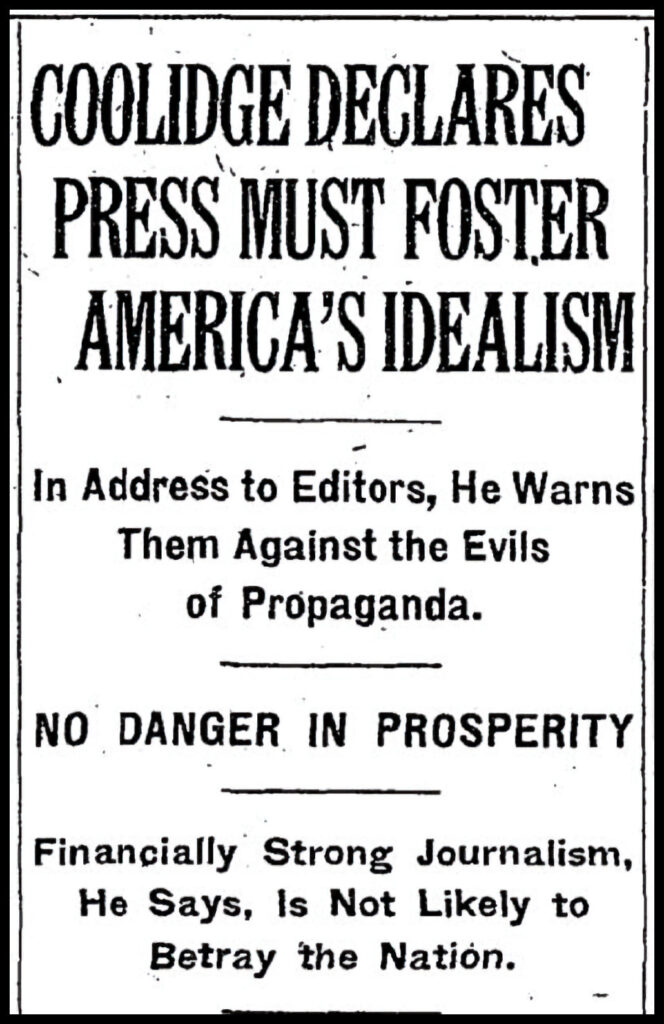
Many newspaper stories about the speech published the following day focused on his comments about idealism. In fact, the New York Times used that aspect of his speech—not his words about “the business of America”—in the headlines and lead paragraphs of its story. You can read NYT article, which includes the full text of Coolidge’s address by clicking this link.
It’s true that Coolidge was generally a pro-business, small-government type politician; sort of a Ronald Reagan without charisma. But if you read his entire speech, you’ll see that the uses of his remark about the “business of the American people” and the spin that often gets put on it are often misleading and overly simplistic.
* * * * * * * * * *
Comments? Corrections? Questions? Post them on the Famous Quotations Facebook page or email me at the email address shown on the “About” page for this blog.
RELATED READING AND VIEWING…