

December 31, 2012

The Top Quotes of 2012 – and some of the top “top quotes” lists of 2012…


Every December, various pundits, writers and media outlets publish lists of what they consider to be the the year’s “top” or “best” quotations — either in general or within a certain realm, such as politics, sports or movies.

Recently, I’ve been perusing some of the lists of quotes from 2012.

The one that’s most widely cited is the top ten quotes of the year list compiled by quote maven Fred Shapiro, associate librarian at Yale Law School and author of the authoritative Yale Book of Quotations.

Now in it’s seventh year, Shapiro’s list gets reprinted by hundreds of newspapers and thousands of websites.

His 2012 list includes several quotes by President Barack Obama and two by his Republican challenger in the 2012 presidential election, Mitt Romney.

In this case, Mitt actually won.

He gained the #1 spot on Shapiro’s list for what became one of the most infamous, clueless and damaging political quotations ever uttered:

“There are 47 percent of the people who will vote for the president no matter what…who are dependent upon government, who believe that they are victims…These are people who pay no income tax…and so my job is not to worry about those people. I’ll never convince them that they should take personal responsibility and care for their lives.”
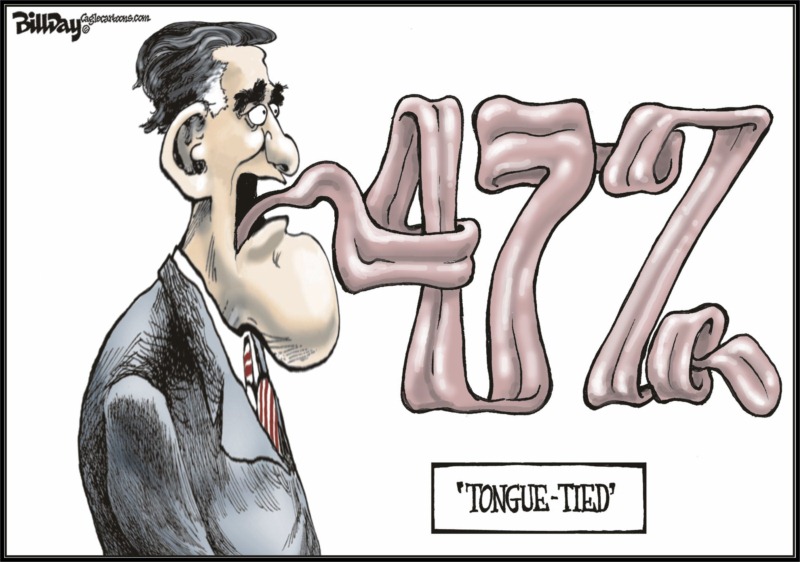
Romney made those remarks at a private fundraiser in Boca Raton, Florida on May 17, 2012. However, they didn’t hit the news until September 17, when a secretly-recorded video of what he said at the fundraiser was released by Mother Jones magazine.

When the story broke, it created a major political firestorm that the Obama campaign stoked to the max.

Romney’s “47 percent” gaffe is also cited by several lists of the top political quotes of 2012.

Many observers believe that quotation played a significant role in turning key swing voters against Romney, by making it appear (or maybe by making it clear) that he didn’t care about the opinions, votes or lives of nearly half of all Americans.

Shapiro’s list of the top 10 quotes of 2012 also includes another gaffe by Romney (“binders full of women”), three quotes by Obama (most notably his “you didn’t build that” quote), Missouri Senatorial candidate Todd Akin’s radioactive “legitimate rape” quote, South Korean rapper PSY’s “Oppan Gangnam style” video meme, a comment by Federal Reserve Chairman Ben Bernanke that popularized the term “fiscal cliff,” and several others that are primarily of interest to political junkies.

Fred left out what I would count as one of the top 10 quotes of the year, but it did make the #1 position in ESPN Playbook’s 2012 “Sports Quotes of the Year” list.
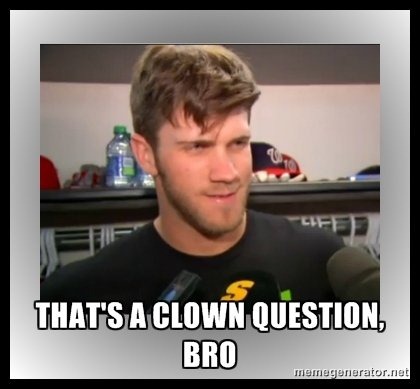
It’s the memorable response by Washington Nationals outfielder

Bryce Harper when a reporter implied that the 19-year-old rookie might take advantage of Canada’s lower drinking age when he played in Toronto and have a beer.

During a a press event on June 13, 2012, a Toronto TV reporter asked Harper: “You got a favorite beer?” 

Harper answered drily:

      “That’s a clown question, bro.” 

It quickly became a viral meme and a popular new all-purpose retort to stupid questions.

There are actually quite a few lists of the top sports quotes of 2012 online.

Some are for hard core fans of certain sports — like the lists of top quotes by and about golfer Tiger Woods or the top quotes by Zlatan Ibrahimovic, the Swedish soccer star (i.e., star of the sport known as football in every country except the US).

As a movie buff, I was interested in reading the lists of top movie quotes of 2012. From what I can tell, almost none seem to have reached the level of being widely-repeated, long-lasting pop culture quotations.

There is one notable exception, mentioned in the list compiled by movie critic Chris Knight:

       “May the odds be ever in your favor.”

It’s a catchphrase from the hugely popular science fiction film The Hunger Games, based on the hugely popular novel by Suzanne Collins

Although you may not know that quote, millions of Hunger Game fans do and it’s cited on hundreds of thousands of websites. (Actually, it appears to be millions based on the Google search hit stats for the phrase.)

There are a number of lists of the “dumbest” or “stupidest” quotes of 2012 online. A large percentage of those are political in nature. So, whether you think the quotes they include are dumb or stupid depends largely on your political leanings.

I found many lists of top 2012 quotes by “celebrities.” They mostly include quotes by people from the realms of TV, movies, fashion or music and those “personalities” who are basically famous for being famous.

I guess such celebrity quote lists are of interest to people who know who the latest celebrities are and are fascinated by what “celebs” do and say. I don’t and am not. So, I quickly got bored reading those lists.
There are also some lists of 2012 quotes of interest to geeks and wonks. Having qualities of both, I found those more intriguing.

For example, there are two “Top Tech Quotes of 2012” lists I like: one on the New Yorker magazine site, complied by Nicholas Thompson and one on the C/NET website, compiled by Jonathan Skillings.

My favorite quote from Thompson’s is “Turn left into the water” — which he cites as the best line from a Tumblr page devoted to the epic failure of Apple’s map app.

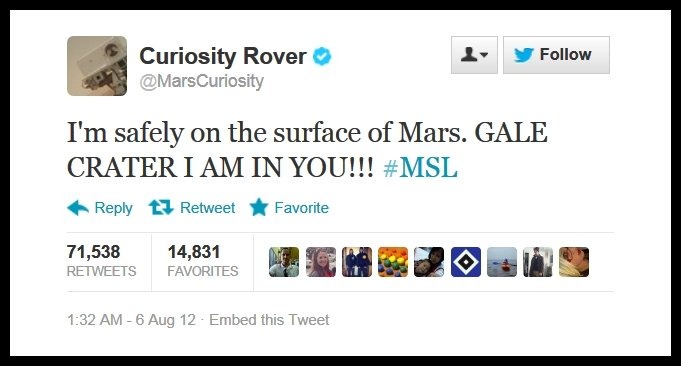
My favorite from Skillings:

       “I'm safely on the surface of Mars. GALE CRATER I AM IN YOU!!! #MSL.”

That was the historic tweet by the Curiosity Rover when it landed in the Gale Crater on the surface of Mars on August 6, 2012.

As a kid in the 1950s, I wondered if there was intelligent life on Mars.

As I was reading some of the lists of the top political and celebrity quotes of 2012, I was reminded of the old joke about whether there’s any on earth.

Happy New Year from ThisDayinQuotes.com. And, good luck to all of us in 2013.

*     *     *     *     *     *     *     *     *     *

Comments? Corrections? Post them on the Famous Quotations Facebook page.

Further reading, viewing and listening…

December 29, 2012

“Bury my heart at Wounded Knee.”


On December 29, 1890, about 500 U.S. Seventh Cavalry troopers gunned down more than 200 Lakota Indians — including men, women and children — at Wounded Knee Creek on the Pine Ridge Reservation in South Dakota.

The Army initially called it “The Battle of Wounded Knee.”

In truth, it wasn’t a battle.

Today, it’s generally called what it really was — the Wounded Knee Massacre.

The famous quote that’s now associated with this tragic event is “Bury my heart at Wounded Knee.”

But those words were not originally written with the infamous massacre in mind.

They come from the poem “American Names,” written by American poet Stephen Vincent Benét and first published in the October 1927 issue of the Yale Review.

Benét’s poem is a patriotic ode expressing his love for American place names.

As he explained in the first verse:

       “I have fallen in love with American names,
       The sharp names that never get fat,
       The snakeskin-titles of mining-claims,
       The plumed war-bonnet of Medicine Hat,
       Tucson and Deadwood and Lost Mule Flat.”

Books of quotations often include this first verse from “American Names” and the final verse, which contains the famous line about Wounded Knee.

They usually omit the fourth verse, which blithely drops the N-word:

       “I will fall in love with a Salem tree
       And a rawhide quirt from Santa Cruz,
       I will get me a bottle of Boston sea
       And a blue-gum nigger to sing me blues.
       I am tired of loving a foreign muse.”

Benét’s seemingly nostalgic use of the old racial slur “blue-gum nigger” and other lines in the poem indicate that he was enamored with the romantic sound of many American place names and was oblivious to (or didn't care about) any potential negative connotations they might have.

The poem’s mention of Wounded Knee is simply as one of those good old American place names, which Benét deems superior to “foreign” names.

In the last verse he suggests that the spirits of American soldiers killed in Europe during the First World War could not find peace in their burial grounds over there.

Speaking in the voice of a dead American soldier, Benét ended the poem with these lines:

       “I shall not rest quiet in Montparnasse.
       I shall not lie easy at Winchelsea.
       You may bury my body in Sussex grass,
       You may bury my tongue at Champmedy.
       I shall not be there. I shall rise and pass.
       Bury my heart at Wounded Knee.”

It was long after the publication of “American Names” that its final line became associated with the Wounded Knee massacre.

That literary connection was made in 1970, when American historian and novelist Dee Brown used Bury My Heart at Wounded Knee as the title of a groundbreaking book that tells the history of the American West from the Indians’ perspective.

Since the publication of Brown’s book, the phrase “Bury my heart at Wounded Knee” has been inextricably linked to the massacre that took place at Wounded Knee on December 29, 1890.

It has also been used to poetically encapsulate a broader sense of loss, sadness and outrage over the historic mistreatment Indians in North America.

Perhaps the most poignant use was by the great Canadian Cree singer-songwriter Buffy Sainte-Marie.

In 1990, she wrote a song titled “Bury My Heart at Wounded Knee” which comments on the continuing abuse of Indians and Indian rights by governments and big corporations.

The chorus goes:

       “Bury my heart at Wounded Knee
       Deep in the earth
       Cover me with pretty lies
       Bury my heart at Wounded Knee.”

I understand that Stephen Vincent Benét is considered to be a great poet and that many people like “American Names.”

Personally, I prefer Dee Brown’s book and Buffy Sainte-Marie’s song. If you read his book and listen to her song, you may understand why some people view Benét’s gushingly patriotic poem as “pretty lies.”


*     *     *     *     *     *     *     *     *     *

Comments? Corrections? Post them on the Famous Quotations Facebook page.

Further reading, viewing and listening…

December 22, 2012

“Let It Snow!” – the Christmas song that isn’t…


On December 22, 1945, a new 78 RPM record by the popular singer and big band leader Vaughn Monroe entered the Billboard “Best Sellers in Stores” chart (a precursor of Billboard’s Top 40 and Hot 100 charts).  

It was the first recording of the song “Let It Snow! Let It Snow! Let It Snow!”

The words were written by the highly successful lyricist Sammy Cahn. The music was by Cahn’s songwriting partner at the time, Jule Styne.

Monroe’s version of the song quickly became a huge hit, making it to Billboard’s number one spot on January 26, 1946.

In the decades since then, “Let It Snow! Let It Snow! Let It Snow!” has been recorded by countless other singers and bands. It’s generally thought of as a standard Christmas song. And, the phrase “Let It Snow” is common on Christmas cards.

However, there’s actually no reference to Christmas or the holiday season in the song’s lyrics.

It’s really a romantic love song about a guy who’s visiting his girlfriend in some unnamed northern location. When it’s time to leave, the weather “is frightful.” It’s snowing too hard for safe travel.

So the lovers snuggle up by the delightful fire, pop some popcorn and enjoy being snowed in. As far as the guy is concerned, it’s a fortuitous situation and he’s happy to “let it snow.” 

In the excellent, well-researched book Stories Behind the Greatest Hits of Christmas, author Ace Collins notes that when Cahn and Styne wrote the song they were sitting in a stifling hot office in Hollywood in the summer of 1945.

Styne worked out a melody he thought sounded “cool” on the piano. Cahn turned his thoughts to winter. “Looking out the window at the California sun baking the landscape, he whispered, ‘Let it snow.’”

In a short time, Cahn and Styne finished what is now considered one of the top 25 Christmas songs — even though it’s not really about Christmas.

Although you may not be old enough to have heard Vaughn Monroe’s original version when it first entered the Billboard chart on December 22, 1945, you’ve heard it if you’re a fan of Bruce Willis.

Monroe’s recording of “Let It Snow! Let It Snow! Let It Snow!” is the first song that plays during the end credits of Willis’ popular action movie Die Hard. It was also used in the soundtrack of Die Hard II.

So, yippee-kay-yay, folks! Click on the video link at right and sing along! Here are the lyrics...

“Oh, the weather outside is frightful
But the fire is so delightful
And since we’ve no place to go
Let it snow! Let it snow! Let it snow!

It doesn’t show signs of stopping
And I brought some corn for popping
The lights are turned way down low
Let it snow! Let it snow! Let it snow!

When we finally kiss good night
How I hate going out in the storm
But if you really you hold me tight
All the way home I’ll be warm.

The fire is slowly dying
And, my dear, we’re still good-bye-ing
But as long as you love me so
Let it snow! Let it snow! Let it snow!”

(NOTE: If you’re interested in early music charts used prior to Billboard’s Top 40 and Hot 100, buy yourself Joel Whitburn's Pop Memories 1890-1954 for Christmas.)

*     *     *     *     *     *     *     *     *     *

Comments? Corrections? Post them on the Famous Quotations Facebook page.

Related reading, listening and viewing…


December 17, 2012

Strange but true / There are lines by the poet Lord Byron you probably didn’t know you knew…


Although Lord Byron (George Gordon Noel Byron) is a very famous English poet, few of us recall many lines from his poems.

Byron’s best known bit of poesy is “She walks in beauty, like the night,” the first line from his poem “She Walks in Beauty” (published in 1815).

Thanks to movies like Ken's Russell's Gothic (1986) and the BBC drama Byron (2003), many of us are also aware that Byron had an outrageously wild personal life.

It was crammed full of sex (possibly including affairs with both male and female lovers and his own sister), drugs (opium in particular) and rocky relations with the British Establishment (which he repeatedly poked in the eye with his scandalous lifestyle and radical liberal politics).

As memorably summed up by one of his many lovers, Lady Caroline Lamb, Byron was “mad, bad and dangerous to know.”

In fact, I’d guess more people are familiar with Byron’s reputation than his poetry.

However, there are some words from a Byron poem that are familiar to almost everyone, in addition to “She walks in beauty...”

On December 17, 1823, Cantos XII, XIII and XIV of Byron’s epic satirical poem Don Juan were first published.

Canto XIV contains the lines:

“‘Tis strange — but true; for Truth is always strange;
       Stranger than fiction.”

Those poetic words by Byron are generally credited as the origin of the proverbial sayings “strange but true” and “truth is stranger than fiction.”

So, although most people don’t know it, they are paraphrasing a quotation by Byron when they use those phrases — both of which could aptly be applied to Byron’s life.

*     *     *     *     *     *     *     *     *     *

Comments? Corrections? Post them on the Famous Quotations Facebook page.

Related reading and viewing…

December 09, 2012

“Baseball been berry, berry good to me!” – the famous SNL catchphrase of Garrett Morris as Chico Escuela…


If you’re old enough to have been watching Saturday Night Live in the late Seventies you might have been watching Episode 5 of Season 4 when it first aired on November 11, 1978. (I am and I was.)

Buck Henry was the host. The Grateful Dead were the musical guests. And, there were several classic skits — including one at the end that introduced what would become a famous TV catchphrase.

The sketch takes place at a meeting of the St. Mickey’s Knights of Columbus.

After dealing with a few business items, the organization’s leader, played by SNL cast member John Belushi, announces that the club would have a special guest speaker that night.

Dan Aykroyd, playing the Knights’ treasurer, notes that the group had to go into debt to pay the speaker’s steep $900 fee.

Belushi then introduces this special guest: “the immortal” Chico Escuela, a former all-star baseball player for the Chicago Cubs who came to the US from the Dominican Republic.

After being introduced, Chico — portrayed by SNL cast member Garrett Morris — gets up, stands at the podium and says in a thick Hispanic accent:

“Thank you berry much. Baseball been berry, berry good to me. Thank you. God bless you. Gracias!”

Then he sits down.

Astonished by the brevity of this $900 “speech,” Belushi’s character asks: “Is that it Chico?”

Chico thinks about it a second, gets up again and adds: “Keep you eye...keep you eyes...on de ball.”

After which, he sits down again.

Belushi says sardonically: “Thank you, Chico. You’ve been an inspiration to all of us.”

Three weeks later, during the December 9, 1978 episode of SNL, Morris’s Chico made a second appearance and repeated his line “Baseball been berry, berry good to me!” several times — making this the night on which it gained official catchphrase status. 

In that episode (Season 4, Episode 8), the host was Monty Python star Eric idle. Kate Bush was the musical guest. Dan Aykroyd performed the insanely funny skit in which he plays a frantic Julia Child, who bleeds to death after cutting her finger. And, Don Novello showed up as Father Guido Sarducci.

Chico was in the
Weekend Update segment with Jane Curtin, who announced that he had been hired as the Weekend Update sports commentator.

After being introduced by Jane (this time as a former New York Mets ballplayer), Chico says:

“Thank you. Thank you, berry, berry much. Baseball been berry, berry good to me. Thank you, Hane.

[A photo of major league player Pete Rose, who had recently signed a four year, 3.2 million dollar deal with the Philadelphia Phillies, appears behind Chico.]

Pete-ee Rose...Baseball been berry, berry good to Pete Rose. Three-point-two-million-dollar para Pete Rose. Charlie Hustle, you bet. Thank you berry, berry much.

In foot-ball... I don’t know football. In Dominican Republic, football is — how you say, Hane? Um, Oh! Soccer! Your football... I don’t know.

In National Hockey League... I don’t know hockey.

In baseball… Baseball been berry, berry good to me! Thank you berry much. Thank you. Thank you berry much. Hane? Thank you, Hane.”

Hearing Chico’s fact-challenged report, Jane responds sarcastically: “Great job, Chico. I’m glad that we haven’t hired just another stupid ex-jock sportscaster.”

Morris went on to appear as Chico Escuela eight more times before leaving the Saturday Night Live cast in the summer of 1980.

Each time, he repeated “Baseball been berry, berry good to me!”(sometimes written as “Beisbol been bery, bery good to me!” and in various other ways). It remains one of the most famous of the many memorable catchphrases created by SNL.

*     *     *     *     *     *     *     *     *     *

Comments? Corrections? Post them on the Famous Quotations Facebook group.

Related reading and viewing…

December 04, 2012

“Facts are stubborn things” – and sometimes “stupid”…


In the years leading up to the start of the Revolutionary War in 1775, the rebel-rousing Sons of Liberty used an engraving of what they called “The Boston Massacre” to arouse anti-British sentiments.

The engraving, done by Paul Revere, shows a line of British soldiers coldly firing their bayoneted muskets into a crowd of Americans, several of which lay bleeding on the ground.

A poem underneath that scene describes how the King’s men “With murderous Rancour stretch their bloody hands, Like fierce Barbarians grinning o'er their Prey.”

It was good propaganda. But it did distort what happened at the “Boston Massacre” on the night of March 5, 1770.

That night, a local resident got into an argument over a debt with a British soldier. Eight other British soldiers came out on the street to help their comrade. A group of Americans surrounded the soldiers. The Brits were soon being yelled at and pelted with snowballs, ice chunks and debris by the much larger, hostile crowd.

The bloodletting appears to have started when a mulatto seaman named Crispus Attucks hit one of the soldiers with a piece of wood. The soldiers panicked. Somebody yelled “Fire!” and they shot into the crowd, killing Attucks and four other Americans.

When the British soldiers were arrested and put on trial for murder, a Boston merchant asked local lawyer (and future president) John Adams to defend them. He agreed, knowing it would make him unpopular and could ruin his career.

Adams believed the soldiers deserved legal representation as a matter of principle. After looking into the incident, he also believed they were provoked and should not be executed for murder, as many Bostonians wanted.

On December 4, 1770, the second day of the brief trial, Adams gave his summation to the jury.

He argued that anyone might have reacted the same way the soldiers did in such a confusing and potentially life-threatening situation. He suggested Crispus Attucks was more to blame for “the dreadful carnage of that night” than the soldiers, because of his “mad behavior.”

Facts are stubborn things,” Adams said, coining a famous quotation. “And whatever may be our wishes, our inclinations, or the dictates of our passions, they cannot alter the state of facts and evidence: nor is the law less stable than the fact; if an assault was made to endanger their lives, the law is clear, they had a right to kill in their own defence; if it was not so severe as to endanger their lives, yet if they were assaulted at all, struck and abused by blows of any sort, by snow-balls, oyster-shells, cinders, clubs, or sticks of any kind; this was a provocation, for which the law reduces the offence of killing, down to manslaughter.”

The jury was persuaded. Six of the soldiers were acquitted. Two were found guilty of manslaughter and punished by having their thumbs branded.

Several years later, John Adams wrote in his diary that his defense of those British soldiers was “one of the best Pieces of Service I ever rendered my Country.”

It was also the origin of the quote “Facts are stubborn things.”

Two centuries later, President Ronald Reagan uttered the most famous modern use and perceived “misuse” of that quote.

It came in his speech at the Republican National Convention in New Orleans, Louisiana on August 15, 1988.

Reagan was there to speak in support of the current Republican presidential candidate, his Vice President George H.W. Bush, who was running against Democrat Michael Dukakis.

In the speech, Reagan recounted what he viewed as the successes of his administration and the reasons why he felt voters should elect another Republican as president.

Reagan repeated John Adam’s facts quote several times in the address. It was a rhetorical device he used in the part that focused on the economic problems he blamed on his Democratic predecessor, President Jimmy Carter.

“Before we came to Washington,” Reagan said, “Americans had just suffered the two worst back-to-back years of inflation in 60 years. Those are the facts, and as John Adams said, ‘Facts are stubborn things.’ Interest rates had jumped to over 21 percent…Facts are stubborn things…The median family income fell 51/2 percent. Facts are stubborn things.

Then he made what became one of his most-cited gaffes, saying:

“Fuel costs jumped through the atmosphere, more than doubling. Then people waited in gas lines as well as unemployment lines. Facts are stupid things.”

Reagan immediately corrected himself, adding: “Stubborn things, I should say.” But once the word stupid came out of his mouth, that’s the version that was picked up and cited by his critics.

Today, thousands of websites quote Reagan as saying “Facts are stupid things” as if it were somehow a significant quote — without noting that it came from a speech in which he said “stubborn things” several other times and quickly corrected his brief slip of the tongue.

Of course, thousands of others note that Reagan said “Facts are stubborn things” — without mentioning that he was quoting John Adams, thus creating the impression that Reagan coined the line.

When it comes to quotations on the Internet, facts are often slippery things.

*     *     *     *     *     *     *     *     *     *

Comments? Corrections? Post them on the Famous Quotations Facebook group.

Related reading and viewing…

Copyrights © 2009-2013 by Subtropic Productions LLC

All original text written for the This Day in Quotes quotations blog is copyrighted by the Subtropic Productions LLC and may not be used without permission, except for short "fair use" excerpts or quotes which, if used, must be attributed to ThisDayinQuotes.com and, if online, must include a link to http://www.ThisDayinQuotes.com/.

To the best of our knowledge, the non-original content posted here is used in a way that is allowed under the fair use doctrine. If you own the copyright to something posted here and believe we may have violated fair use standards, please let us know.

Subtropic Productions LLC and ThisDayinQuotes.com is committed to protecting your privacy. For more details, read this blog's full Privacy Policy.