

If you start looking into claims about the origins of common phrases, you find that many of those claims are myths that have simply been repeated so long that they came to be cited as true.
Some of these bogus phrase “origins” are based on the earliest example recorded in the venerable Oxford English Dictionary
Now, by searching resources like Google Books it is much easier to verify — or disprove — claims about the “first use” of phrases.
And, it’s not uncommon for modern researchers to find out that what has long been called the origin or earliest recorded use of a phrase is neither.
For example, many books and websites say the term “a self-made man” was coined by the American politician Henry Clay (1777-1852).
While serving as the U.S. Senator for Kentucky, Clay made a speech on the floor of the Senate on February 2, 1832 in which he said:
“In Kentucky, almost every manufactory known to me, is in the hands of enterprising and self-made men, who have acquired whatever wealth they possess by patient and diligent labor.”

The Oxford English Dictionary lists this as the first recorded use of the term “self-made men.”
Thus, writers of a number of books and Internet posts have assumed that this was the origin of both “self-made men” and the singular version “self-made man.”
But, in fact, it wasn’t.
I discovered this by using another great online research tool, Newspaper Archive.com, has searchable PDF copies of American newspapers going back to the early 1700s.
I did a search in NewspaperArchive.com and quickly found an earlier use of “self-made man.”
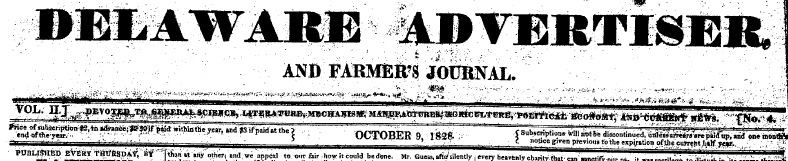
It’s in a letter signed by a “Prof. Newman” that was published in the October 9, 1828 issue of the Delaware Advertiser and Farmer’s Journal.
The heading above the letter is “A SELF MADE MAN” (with no hyphen).
Newman’s letter is about Roger Sherman (1721–1793), the Connecticut statesman and politician who served on the “Committee of Five” that drafted the Declaration of Independence and later served as Connecticut’s Senator in the new U.S. Congress.
Professor Newman’s letter notes that Sherman rose from humble beginnings to “the Halls of our Congress” and “was a self made man.”
So, while the term “a self-made man” is associated with the date February 2nd, the reason for the association is that it has long been believed that Henry Clay’s speech on February 2, 1932 was the origin of the term.
I have now disproved that belief.
Stop the presses on the next edition of the Oxford English Dictionary! I have an edit…
* * * * * * * * * *
Comments? Corrections? Post them on the Famous Quotations Facebook page.
Related reading…