

The idiomatic expression “on a wing and a prayer” is a now widely used to describe doing something under extremely difficult or disadvantageous circumstances and hoping that sheer luck, determination and/or God will allow its success.
During World War II, when the phrase first became part of the English language, it had a literal application.
It referred to Allied airmen flying back to their base in damaged planes, hoping and praying that they’d make it.
In his Dictionary of Catch Phrases
He thought it might have been used by RAF pilots as early as 1940.
That’s possible. But there are no newspapers or other sources I could find online that used the phrase prior to 1943, which is when it was made famous by an American song inspired by news stories about an American bomber crew.
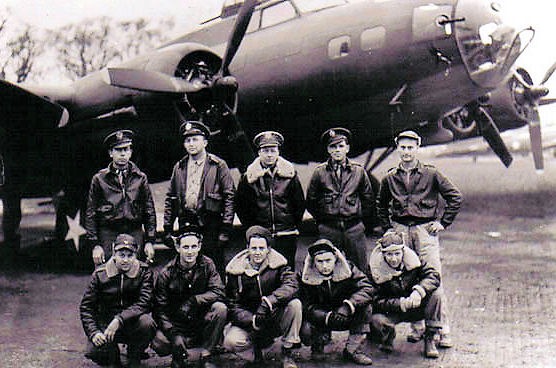
On February 26, 1943, a B-17 “Flying Fortress” bomber piloted by Hugh G. Ashcraft, Jr. of Charlotte, North Carolina was limping back from a bombing mission in Germany to an American base in England.
The plane, dubbed The Southern Comfort by its crew, had been riddled by flak and was damaged severely, “with a hole four feet square in the rudder, the nose shattered and the Number 3 engine spewing oil and flames.”
As they approached the shores of Britain, Ashcraft told his men over the radio: “Those who want to, please pray.”
Miraculously, Ashcraft got the The Southern Comfort to its home base and landed it safely, generating news in his home state of North Carolina and elsewhere about the pilot and crew that “prayed” their plane back.
The incident made Ashcraft a local celebrity. After the war, he became the first president of the Harris Teeter chain of supermarkets, which was first established in North Carolina and grew to have 243 stores in seven states.
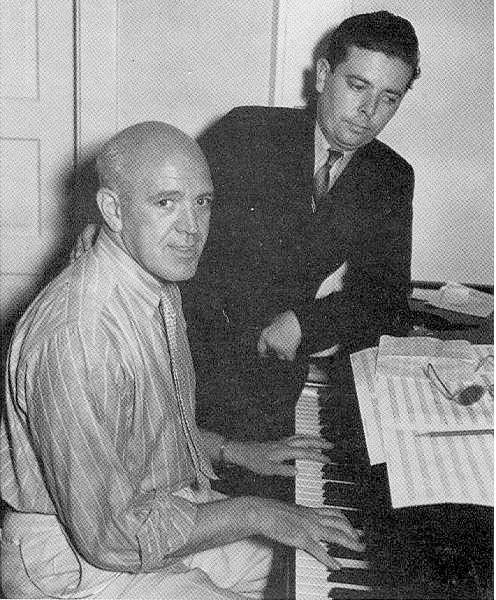
The stories about Ashcraft’s cool-headed bravery and his suggestion to pray inspired the songwriting team Harold Adamson and Jimmy McHugh to write a new patriotic song.
The catchy phrase that popped into the mind of Adamson, the lyricist, was “Comin’ in on a Wing and a Prayer.”
He used it as the title of the song and in the chorus, which goes:
“Comin’ in on a wing and a prayer.
Comin’ in on a wing and a prayer.
Though there’s one motor gone, we can still carry on,
Comin’ in on a wing and a prayer.”
The first popular version of the song, recorded by The Song Spinners
Their version quickly became a hit. Soon, the song was being recorded and performed live by a long list of other singers, groups and bands, making it one of the biggest hits of the year.
One of the hippest versions recorded in 1943 was by a black vocal group from Missouri called The Four Vagabonds. (If you haven’t heard it, get hip by clicking this link to listen to it.)
I also personally love the far more recent cover of the song by Ry Cooder, on his 1972 album Boomer’s Story
If you’re a World War II history buff, you may know that the song also inspired the title of the 1944 movie Wing and a Prayer (a.k.a. A Wing and a Prayer: The Story of Carrier X).
That classic film, starring Dana Andrews and Don Ameche, is about American aircraft crews. However, it’s set in 1942 in the Pacific theater and is not about The Southern Comfort or B-17s.
If you’re highly-knowledgeable about aviation history, like my late friend writer Robert F. Dorr, you may know the aircraft primarily featured in the film are Grumman TBF Avenger torpedo bombers, Grumman F6F Hellcat fighters and Curtiss SB2C Helldiver dive bombers. You’d have to be a serious expert on planes, like Bob, or a student of anachronisms in movies, to know those planes weren’t actually used on U.S. Navy carriers until 1943.
Anyway, the fame of Adamson and McHugh’s hit song of 1943, which lent its title to a popular film the following year, firmly embedded “a wing and a prayer” in our language.
It’s a phrase that’s still familiar to most people, even if they’ve never heard the song or the story behind it.
* * * * * * * * * *
Comments? Corrections? Post them on my Famous Quotations Facebook page or send me an email.
Related reading, listening and viewing…


![A Wing and a Prayer [DVD]](https://m.media-amazon.com/images/I/51+VW0ukFkL._SL500_.jpg)
