

Back in my college days, I tended to snigger at drug references in rock songs. So, I probably sniggered when I first heard Mick Jagger sing the lines in the Rolling Stones’ 1969 song “Let It Bleed” that go:
“Baby, you can rest your weary head right on me
And there will always be a space in my parking lot
When you need a little coke and sympathy”
Nowadays, I’m more intrigued by the fact that in using the phrase “coke and sympathy” Jagger and his songwriting partner Keith Richards were riffing on the expression “tea and sympathy.”
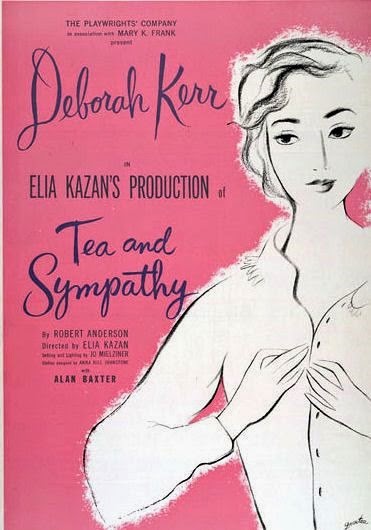
That phrase was popularized by the play Tea and Sympathy, written by American playwright Robert Anderson (1917-2009). It debuted at the Barrymore Theatre in New York City on September 30, 1953.
Since then, the phrase “tea and sympathy” has been used as an expression that means showing kindness and lending a sympathetic ear to someone who is troubled or upset.
The play was a groundbreaking exploration of the issues of sexual identity, social prejudice against homosexuals and the repression and rebellion of women stuck in loveless traditional marriages.
Because of certain things that happen in it, “tea and sympathy” is sometimes said with a nudge-nudge-wink-wink, to suggest the idea of giving someone sympathy as a ploy to seduce them.
In the play, a sexually ambiguous teenage boy at a boarding school gets harassed for not meeting the manliness standards of the day. He is widely suspected of being gay.
The boy, named Tom Lee, is befriended by a faculty member’s lonely and sexually-frustrated wife, Laura Reynolds, played by Deborah Kerr in the original production.
In Act One her unlikeable, domineering husband Bill warns her not to pay too much attention to the students or get involved in their lives. He utters the line that gave the play its name, telling her:
“All you’re supposed to do is every once in a while give the boys a little tea and sympathy.”
Laura ends up offering Tom a bit more “tea and sympathy” than Bill had in mind, if you know what I mean (nudge-nudge-wink-wink).
She also ends up leaving her jerk of a husband.
In the last scene, speaking to Tom, she says the line that became a famous quotation.
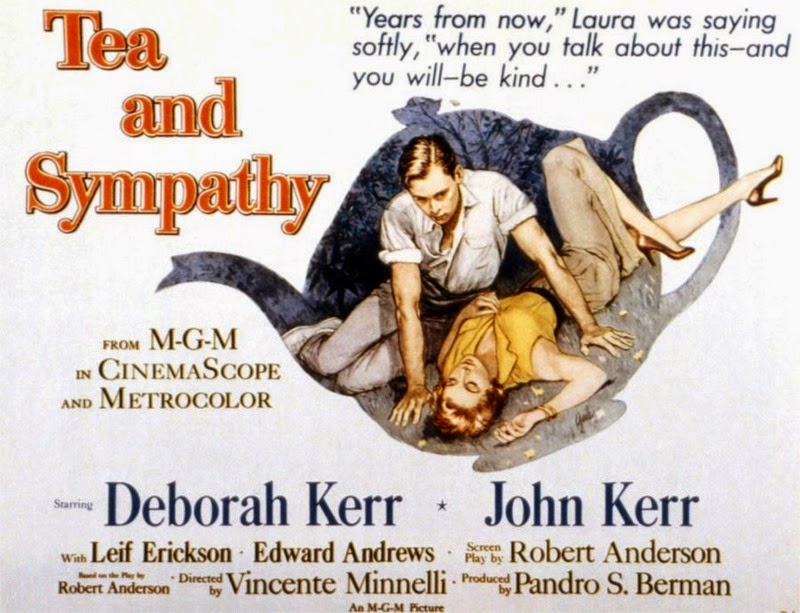
“Years from now, when you talk about this—and you will—be kind.”
That’s the closing line in the play. At that point, the written stage directions say: “Gently she brings the boy’s hands towards her opened blouse, as the lights slowly dim out…” The end.
MGM produced a movie adaptation of the play in 1956, which also starred Deborah Kerr. But in that, the sexually-oriented themes of the play were toned down to comply with the puritanical absurdities of the Motion Picture Production Code (aka the Hays Code).
For example, MGM decided that the play’s original ending would violate the Code’s rules requiring any non-marital sex to be portrayed as immoral. So the studio execs ordered a contrived, politically-correct epilogue to be added.
In the film’s closing scenes, we flash forward ten years and see that Tom has become a manly married man and Laura regrets her sinful behavior. (Yawn.)
I wonder how Mick Jagger and Keith Richards would have rewritten the ending.
* * * * * * * * * *
Comments? Corrections? Post them on my quotations Facebook group.
Related reading…


