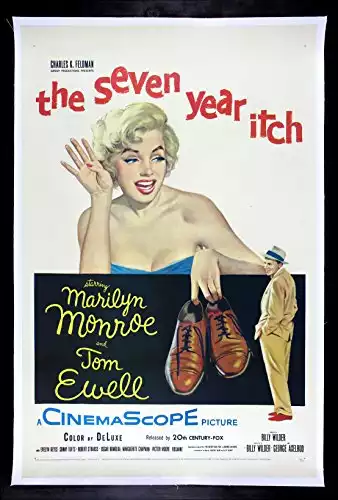

On November 20, 1952, the play The Seven Year Itch by George Axelrod debuted on Broadway at the Fulton Theatre.
It starred Tom Ewell, as a married man attracted to a gorgeous young neighbor, played by Vanessa Brown.
Ewell was also in the famous 1955 movie version of The Seven Year Itch, directed by Billy Wilder.
But, in the film, the object of his desire was Marilyn Monroe.
It was one of Monroe’s most memorable roles. And, the scene in which her white dress blows up around her shapely legs when she stands on a subway grate has became an iconic cultural image
The play and the movie were both big hits.
Together, they popularized the term “seven year itch” in its marital and sexual sense: a shorthand way of suggesting that even previously-faithful married people (especially husbands) tend to get an urge, or “itch,” to have an extramarital affair after years of marriage.
Playwright and screenwriter Axelrod is generally given credit for creating this current meaning. But he didn’t coin the phrase itself.
Before Axelrod’s play, the term “seven year itch” was a common slang name applied to any of several contagious diseases that caused itchy or otherwise annoying skin conditions, ranging from scabies to certain STDs.
This older use of the term goes back to the early-1800s and was still in common use during the first half of the 20th century.
Thanks to modern antibiotics, the diseases it applied to and the use of term in connection with skin conditions had become less common by the mid-1950s.
Then, thanks to Axelrod’s play and the particularly huge success of the 1955 movie version with Marilyn Monroe, “seven year itch” was given a whole new life — and a significantly different meaning.
* * * * * * * * * *
Comments? Corrections? Post them on the Famous Quotations Facebook group.
Related reading, viewing and stuff…