
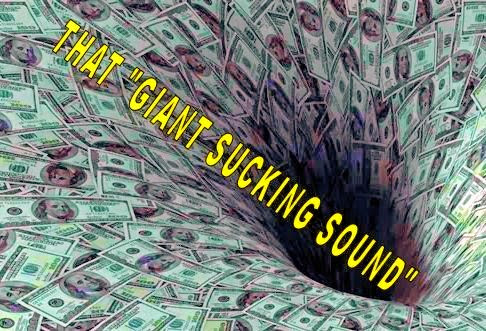
The huge amount of attention focused on the 2016 presidential debates between Donald Trump and Hillary Clinton made me think of some of the famous quotations from past presidential debates.
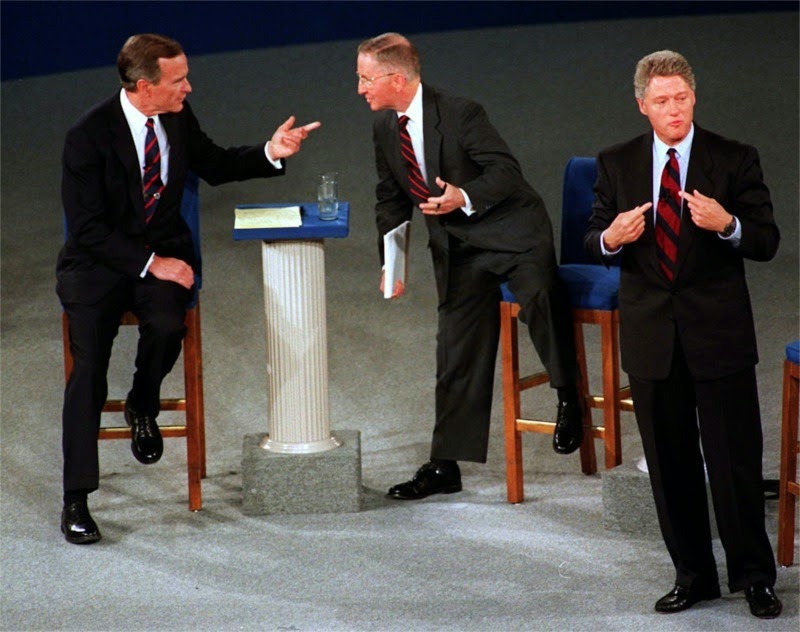
One that coined a phrase still widely used today was uttered by Independent candidate Ross Perot on October 15, 1992, in the three-way presidential debate between Perot, Republican President George H. W. Bush and Democratic nominee Bill Clinton.
During that debate, Perot made a prediction about the effects of the proposed North American Free Trade Agreement (NAFTA). Many people today would view it as prescient.
“If you’re paying $12, $13, $14 an hour for factory workers and you can move your factory south of the border, pay $1 an hour for your labor, have no health care, have no environmental controls, no pollution controls and no retirement, and you don’t care for anything but making money, then there will be a giant sucking sound going south.”
That quote by Perot was included in hundreds of news reports about the presidential debate. Probably thousands.
Few people remember his entire sentence nowadays, but the catchy phrase “a giant sucking sound” quickly gained what turned out to be long-lasting fame.
 It is still regularly used and repurposed.
In fact, on almost any day, if you do a Google news search on “giant sucking sound” you’ll usually find the phrase in dozens of recent news-related stories and blog posts, even though the stories may not mention its source and many readers may be unaware of it — or of Ross Perot.
My own view is that it’s the familiarity of the line or phrase and its longevity that qualifies it as “famous quotation.” It’s not whether most people remember the specific origin or coiner.
It’s often not immediately apparent whether a line or phrase will rise to the level of being a truly famous quote. Many are just “famous for 15 minutes.”
That’s why one of my favorite quotation mavens, Nigel Rees
“Remember the dreadful example of the 1999 edition of the Oxford DQ, stuffing in remarks and supposedly quotable lyrics from the Spice Girls?” Rees wrote in an issue of his great “Quote…Unquote” newsletter. “What a surprise that they have mostly gone from the most recent edition.”
On the flip side, many scholarly quotation reference books like Bartlett’s Familiar Quotations
These less familiar quotes may be worthy bits of wisdom or wit, or worth knowing for the purpose of cultural literacy. But they are not necessarily what I would call “famous quotations.”
My own working definition of a famous quotation is a quote that is both widely known in part or in its entirety and which has had, or is clearly likely to have, a long life in our language — a line or phrase that is frequently and widely cited, quoted, praised, mocked, misquoted, adapted, recycled or repurposed.
In October 2016, everybody heard a lot about a crass quote by Donald Trump, recorded on a “hot mic” when he was getting ready to appear on the TV show Access Hollywood in 2005, after it was revealed to the press at the height of the 2016 presidential campaign.
“I’m automatically attracted to beautiful [women]—I just start kissing them. It’s like a magnet. Just kiss. I don’t even wait. And when you’re a star they let you do it. You can do anything…Grab them by the pussy. You can do anything.”
It’s not clear whether those words will rise to the level of being a long-remembered and oft-cited “famous quotation.”
Hopefully, they won’t become a famous presidential quotation.
* * * * * * * * * *
Comments? Corrections? Post them on my quotations Facebook group.
Related reading…