

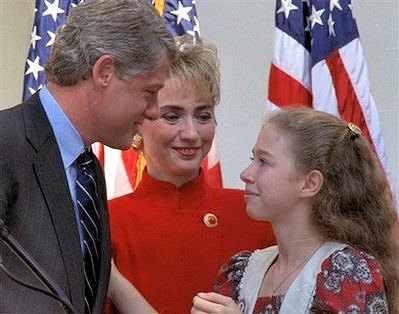
On October 3, 1991, Arkansas Governor Bill Clinton, held a press conference in Little Rock to announce that he was officially running as a candidate to be the Democratic nominee for President of the United States.
It became become closely associated with him after he won the Democratic nomination and used it in subsequent stump speeches during the 1992 presidential election.
In his speech on October 3, 1991, Clinton spoke of “the forgotten middle class” three times.
At the beginning, after thanking his wife Hillary, his daughter Chelsea and his friends and supporters, he said:
“All of you, in different ways, have brought me here today, to step beyond a life and a job I love, to make a commitment to a larger cause: preserving the American Dream; restoring the hopes of the forgotten middle class; reclaiming the future for our children.”
In the middle of the speech, Clinton said:
“Together I believe we can provide leadership that will restore the American dream — that will fight for the forgotten middle class.”
Finally, he closed by saying:
“This is not just a campaign for the Presidency – it is a campaign for the future, for the forgotten hard-working middle class families of America who deserve a government that fights for them.”
After that, Clinton used and reused the term “the forgotten middle class” many times in his stump speeches on the way to winning the Democratic nomination and then the presidential election of November 1992.
So, it’s no wonder that his use of the phrase is the most famous.
But he didn’t coin it.
Republican politician Alfonse D’Amato used the slogan, “A Fighter for the Forgotten Middle Class” in his successful 1980 campaign to win a New York Senate seat.
Before that, in 1977, “the forgotten middle class” was used in newspaper interviews by Pat Caddell, the pollster and political strategist for then Democratic Presidential Candidate Jimmy Carter.
Before that, it was used by a number of other politicians and candidates in the 1960s.
And, of course, “the forgotten middle class” was inspired by a similar rhetorical phrase made famous in the early 1930s by Franklin D. Roosevelt: “the forgotten man at the bottom of the economic pyramid.”
But we’re not quite at the bottom of the quote pyramid yet.
Roosevelt’s famed phrase was inspired by the “the forgotten man,” a term coined by Yale social scientist William Graham Sumner.
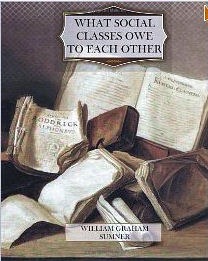
He used it as the title of a scholarly essay that was published in his 1883 book What Social Classes Owe to Each Other.
Sumner may have been inspired by some earlier phrase but, if so, it has apparently been forgotten.
* * * * * * * * * *
Comments? Corrections? Post them on the Famous Quotations Facebook page.
Related reading…


