

On October 14, 1968, Congressman Henry S. Reuss of Wisconsin made some remarks on the floor of Congress that included what became a very famous quotation – or, more accurately, a very famous misquotation.
The “quote” Reuss read was recorded in the Congressional Record as follows:
“When Hitler attacked the Jews, I was not a Jew, therefore, I was not concerned. And when Hitler attacked the Catholics, I was not a Catholic, and therefore, I was not concerned. And when Hitler attacked the unions and the industrialists, I was not a member of the unions and I was not concerned. Then, Hitler attacked me and the Protestant church – and there was nobody left to be concerned.”
Reuss credited these words to Howard J. Samuels, a New York businessman who was the Administrator of the Small Business Administration and, according to Reuss, “a leader of the Nation’s Jewish community.”
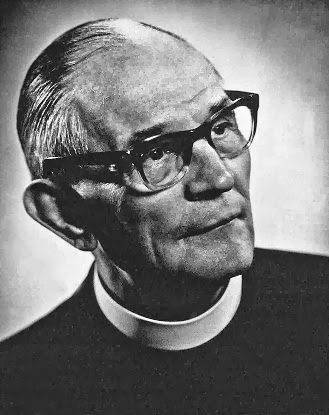
It was soon pointed out that the quote was not created by Samuels, but was actually a version of words spoken by the German theologian and Lutheran pastor, Martin Niemöller (1892-1984).
Today, many books and thousands of websites attribute the lines in the Congressional Record to Niemöller .
Pastor Niemöller was one of the brave German church leaders who spoke out publicly against the Nazis’ persecution of Jews and other minority groups while Adolf Hitler was in power. He was arrested and put in a Nazi concentration camp for his views, but survived.
In 1946, after World War II ended, he began talking in his sermons and speeches about the collective guilt Germans shared for going along with Hitler’s atrocities.
A paraphrase of Niemöller’s remarks on this topic was cited in the 1955 book by Milton Mayer, They Thought They Were Free: The Germans, 1933-45.
Mayer wrote that a German friend of his told him:
“Pastor Niemöller spoke for the thousands and thousands of men like me when he spoke (too modestly of himself) and said that, when the Nazis attacked the Communists, he was a little uneasy, but, after all, he was not a Communist, and so he did nothing; and then they attacked the Socialists, and he was a little uneasier, but, still, he was not a Socialist, and he did nothing; and then the schools, the press, the Jews, and so on, and he was always uneasier, but still he did nothing. And then they attacked the Church, and he was a Churchman, and he did something—but then it was too late.”
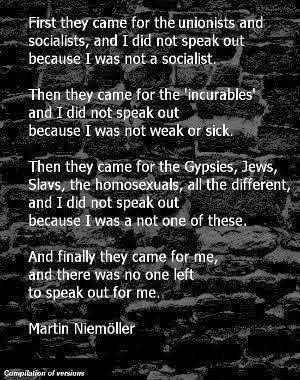
Eventually, someone (possibly Howard Samuels) turned this book’s account of what Niemöller said into the “quote” Rep. Reuss read into the Congressional Record on October 13, 1968.
Then some other unknown person turned that famous misquote into a popular poem which was and still is commonly attributed to Pastor Niemöller.
Many different versions of this poem have been published in books and on the Internet, naming various groups in varying order.
One of the most common versions starts with “the Jews” and goes like this:
“First they came for the Jews and I did not speak out because I was not a Jew.
Then they came for the Communists and I did not speak out because I was not a Communist.
Then they came for the trade unionists and I did not speak out because I was not a trade unionist.
Then they came for me and there was no one left to speak out for me.”
Other common versions start with “Communists” or “Socialists.”
The bottom line is this: Pastor Niemöller did say some things in his sermons that are similar to the lines given in the Congressional Record, in Mayer’s 1955 book and the poetic variations.
But there is no written record of him saying anything exactly like any of those “quotes.”
Interestingly, the version read by Congressman Reuss omitted Communists and Socialists. In 1968, the Cold War was still ongoing and no savvy American politician could publicly sympathize with “Reds.” So, Ruess inserted “industrialists” in their place.
Niemöller himself did not mention industrialists in his sermons about people the Nazis persecuted, since they were not one of the groups the Nazis targeted. But he did mention Communists and Socialists, since they were in fact persecuted by the Nazis.
Indeed, when his “quote” became famous and Niemöller was asked about it, he said he preferred the versions that included Communists and Socialists.
The most definitive research I’ve seen about all this was done by Harold Marcuse, a professor of German history at the University of California, Santa Barbara.
Marcuse posted a summary of his research online and it’s well worth reading if you’re a fan of this famous saying.
* * * * * * * * * *
Comments? Corrections? Post them on the Famous Quotations Facebook page.
Related viewing, reading and listening…